Costs
Part of Five home coffee experiments any curious beginner can run alone
4 pointers on independent brands aside that hold up
Four pointers for judging independent coffee brands: roast dates, equipment fit, subscription value, and how to test a bag before you commit.
Four pointers decide whether an independent coffee bag earns a second order: roast date, fit with your gear, subscription terms and one honest side-by-side test. Each check takes minutes and costs less than a wasted bag.
Roast date and origin do more work than packaging, and where the value in an independent bag comes from is worth reading before you spend.
What to take away
- Pointer 1, roast datebuy only bags that print one, and treat a best-before date as no date at all.
- Pointer 2, gear fitask for a recommended dose and ratio, then check your grinder reaches that grind.
- Pointer 3, subscription termsbuy one bag first, and subscribe only where you can pause, skip and cancel online.
- Pointer 4, side-by-side testbrew the new bag beside a coffee you trust, same dose and same water, one change at a time.
- A wrong call costs moneya 12 oz bag typically runs about $18 to $24, so testing beats guessing.
The roast date rule, and what a missing one means
A printed roast date is the most useful line on a bag. A best-before date says when a company wants the coffee sold, not when it was roasted.
If a bag carries no roast date and no roast week, put it back. No label art is worth that gamble.
Freshness fades unevenly. A washed Ethiopian at ten days tastes different from a natural Brazilian at ten days, so the date is a starting point, not a verdict.
Look for brands that print it. Counter Culture Coffee prints a roast date on every bag. George Howell Coffee prints roast dates and roasts to order. Both claims are checkable on a product page before you pay a cent.
Gear fit: beans your grinder can actually reach
Compact setups punish mismatched beans. A dense, light roast stalls a hand grinder set fine. An oily dark roast clogs a paper filter.
Your grinder sets the finest grind you can reach, and coffee grinder design decides how much range you have before the burrs rub. Check that before buying a bean your kit cannot extract.
Ask the brand what brew method and dose it recommends. A roaster that answers with a gram dose and a ratio is roasting for drinkers. Onyx Coffee Lab publishes brew recipes with a dose and ratio for each coffee. Verve Coffee Roasters lists recommended brew methods on its product pages.
If your shelf holds one brewer and one grinder, buy in the order that keeps each purchase useful before adding beans.
Subscription terms to read before the first charge
A subscription is a commitment dressed as convenience. Buy the first shipment as a single bag, then decide whether you want a standing order.
Three terms matter: the gap between roast date and ship date, the cancellation route, and whether you can skip a month.
A workable policy has three parts:
Subscription terms
- Skip any shipment up to seven days before the ship date.
- Cancel online from the account page, with no email required.
- No minimum number of shipments.
If stopping a charge needs an email or a phone call, treat that friction as part of the price.
A two-bag monthly shipment typically lands near $40 to $50 with shipping, a typical range rather than a quote, which sets your break-even against buying single bags.
A subscription that lets you swap origins between shipments is the cheapest way to learn what you like, and judging a subscription box for a small kitchen covers the rest of the calculation. Counter Culture Coffee and Madcap Coffee both run accounts you manage online.
The one-bag side-by-side test
Buy one bag. Brew it beside a coffee you already know, then change one variable at a time.
One-bag side-by-side test
- Weigh both coffees to the same dose. 15 g is a common starting point.
- Brew both with one method and one ratio. Coffee to water ratios of about 1:16 by weight are a common filter starting point.
- Grind both at the same setting if the grinder allows it.
- Taste both warm, write the first impression down, and change nothing else.
- Repeat the next morning before you decide.
Hold the water constant. Hardness varies by region and shifts extraction, so water hardness is worth knowing before you blame the coffee.
This is the discipline behind how to taste and compare two brews side by side, and one week of it uses about 120 g of beans.
Keep notes from the first morning. Rebuilding a week from memory produces a record that agrees with what you already believed.
Testing also throws off more spent grounds than normal brewing. Dry a jar's worth or compost the rest, then return to the buying question.
Example: what a week of testing costs
What a week of testing costs
| Test | Extra coffee used | Extra time |
|---|---|---|
| Dose ladder, two weeks | about 30 g | none |
| Grind against time, one week | none | two minutes a day |
| Freshness curve, one month | none | none |
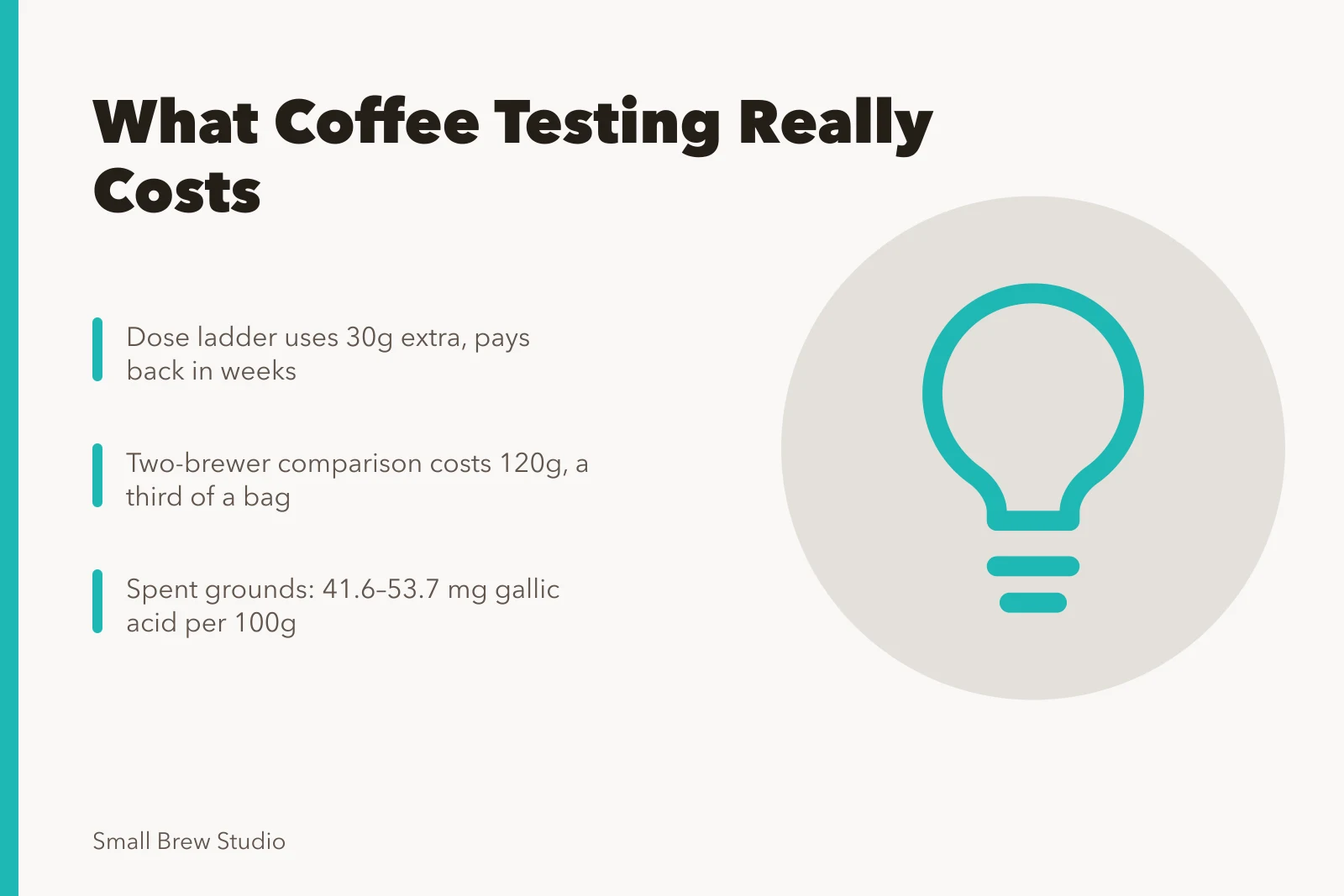
| Two-brewer comparison, one week | about 120 g | ten minutes a session |
Only the last row costs real money. A 12 oz (340 g) bag from a US roaster typically runs about $18 to $24, a typical range rather than a fixed price. Two brewers for one week uses a third of a bag, so about $6 to $8 spent to avoid a $40 to $60 brewer you would have regretted.
The dose ladder pays for itself. Most people dose above the point where sweetness peaks, so the test usually ends with less coffee per cup. Cutting 1 g per cup twice a day is about 730 g a year, two to three bags. At about $20 a bag, that is roughly $40 to $60 back.
When a roaster raises a bag price, check the weight and the origin. A higher price on a smaller bag from a different farm is a quiet downgrade, not a fair increase.