Reviews
Part of Small space coffee gear under review: the good, the weak and the verdict
How to judge a coffee gear subscription for a small kitchen: the short version
Why gear subscriptions suit small kitchens badly, how to judge one anyway, and how to tell a genuine improvement from a laboratory result you cannot buy.
No boxes are named here, because I have not subscribed to competing services and a list built from their own marketing would be worthless. What follows is why gear subscriptions and small kitchens are a poor fit, and how to judge one if you want it anyway.
What to take away
- A subscription that adds objects is structurally wrong for a kitchen with no storage.
- Novelty in brewing research is real and mostly not purchasable.
- Judge a gear box on whether items replace things rather than accumulate.
- Consumables subscriptions work where object subscriptions do not.
The structural problem
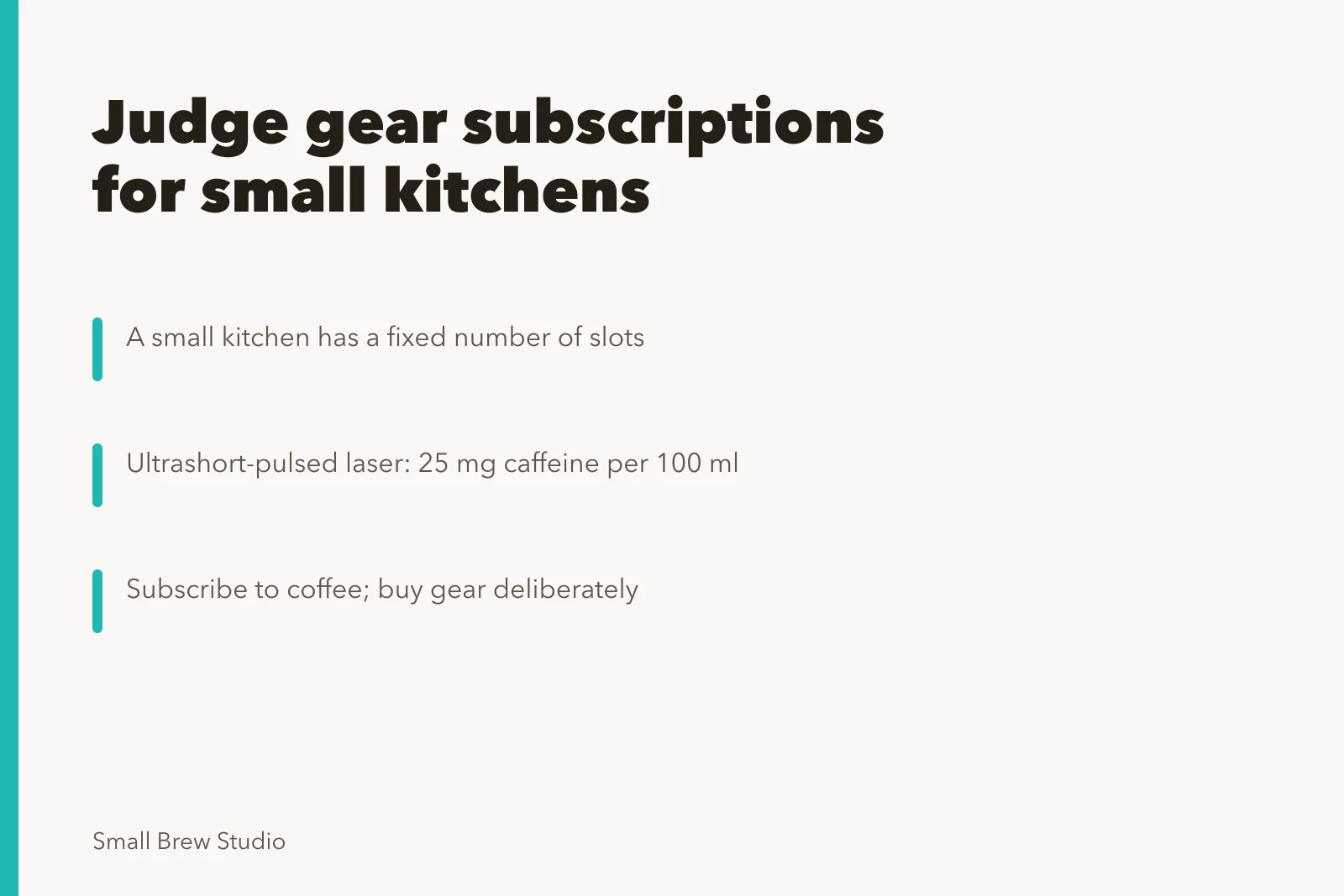
A small kitchen has a fixed number of slots. A subscription that delivers an object every month fills them, and then keeps going. Within a year you own three brewers, two of which you do not use, and the counter is worse than when you started.
Small kitchen vs pantry
Small kitchen
- Storage
- Fixed slots
- Failures
- Nowhere to go
- Delivery
- Decision in a week
- After a year
- Three brewers
House with pantry
- Storage
- Room to spare
- Failures
- Put somewhere
- Delivery
- Pleasant to try
- After a year
- Variety tried
This is not a criticism of any particular service; it is arithmetic. In a house with a pantry, the same subscription is a pleasant way to try things, because failures can be put somewhere.
In a one-cupboard kitchen, failures have nowhere to go, so every delivery becomes a decision within a week. A small kitchen only works on a rule that nothing arrives without something leaving.
Novelty is not availability
Gear marketing borrows research language, so know what the research looks like. A study used an ultrashort-pulsed laser on a coffee suspension at room temperature. It reached about 25 mg of caffeine per 100 ml after three minutes of irradiation, comparable to traditional preparations.
Cold brew time: lab vs normal
- 12hoursTraditional cold brew
- 3minutesLaser method
That is a real result and it is a picosecond laser system. It is not arriving in a subscription box. When a box promises a breakthrough, the useful question is whether the thing is a product or a paper. Ultrasound has reached the same three-minute figure from another direction, and none of that is a home purchase yet either.
The same applies at the other end of the process. Reviews of spent coffee ground valorization examine routes such as fuel pellets, and note that burning pellets made from 100 percent spent coffee grounds is not feasible due to high nitrogen oxide emissions and incomplete combustion. Interesting, researched, and not a thing you can do with your morning grounds.
If you want one anyway
| Ask | Good answer |
|---|---|
| What arrives each month? | Consumables, not objects |
| Can I skip an object month? | Yes, without a call |
| Are filters and spares included? | Yes, for gear I already own |
| Is there a return path? | Yes, for unopened items |
| What is the smallest tier? | One that fits your storage |
The consumables answer is the important one. Filters, cleaning tablets and coffee are all things a small kitchen consumes rather than stores, so they leave no permanent trace. Brewers are not, and neither are jugs, stands, tampers or scoops.
The alternative that usually works better
Subscribe to coffee; buy gear deliberately. Coffee is consumed, so it cannot accumulate. It is the input that changes your cup.
Gear should be bought once, after a defined problem appears, which is the same test worth applying to any purchase, and if the appeal of a box is variety rather than objects, a coffee subscription delivers that more honestly.