Industry
Part of Five home coffee experiments any curious beginner can run alone
Population surveys are changing how home coffee habits get studied
How coffee research is shifting: large volatile fingerprint datasets, population surveys of everyday drinking, and what either one means at home.
Coffee research has been moving in two directions at once: very large chemical datasets on one side, and population surveys of ordinary drinking habits on the other. Neither produces advice you can apply directly, and both are worth understanding.
What to take away
- Volatile fingerprinting is now being done at a scale that can separate quality levels.
- Population studies of everyday coffee drinking are getting more specific about who and how much.
- Both kinds of study describe averages, and you are not an average.
- The home version of all this is still one variable at a time.
Chemical fingerprints at scale
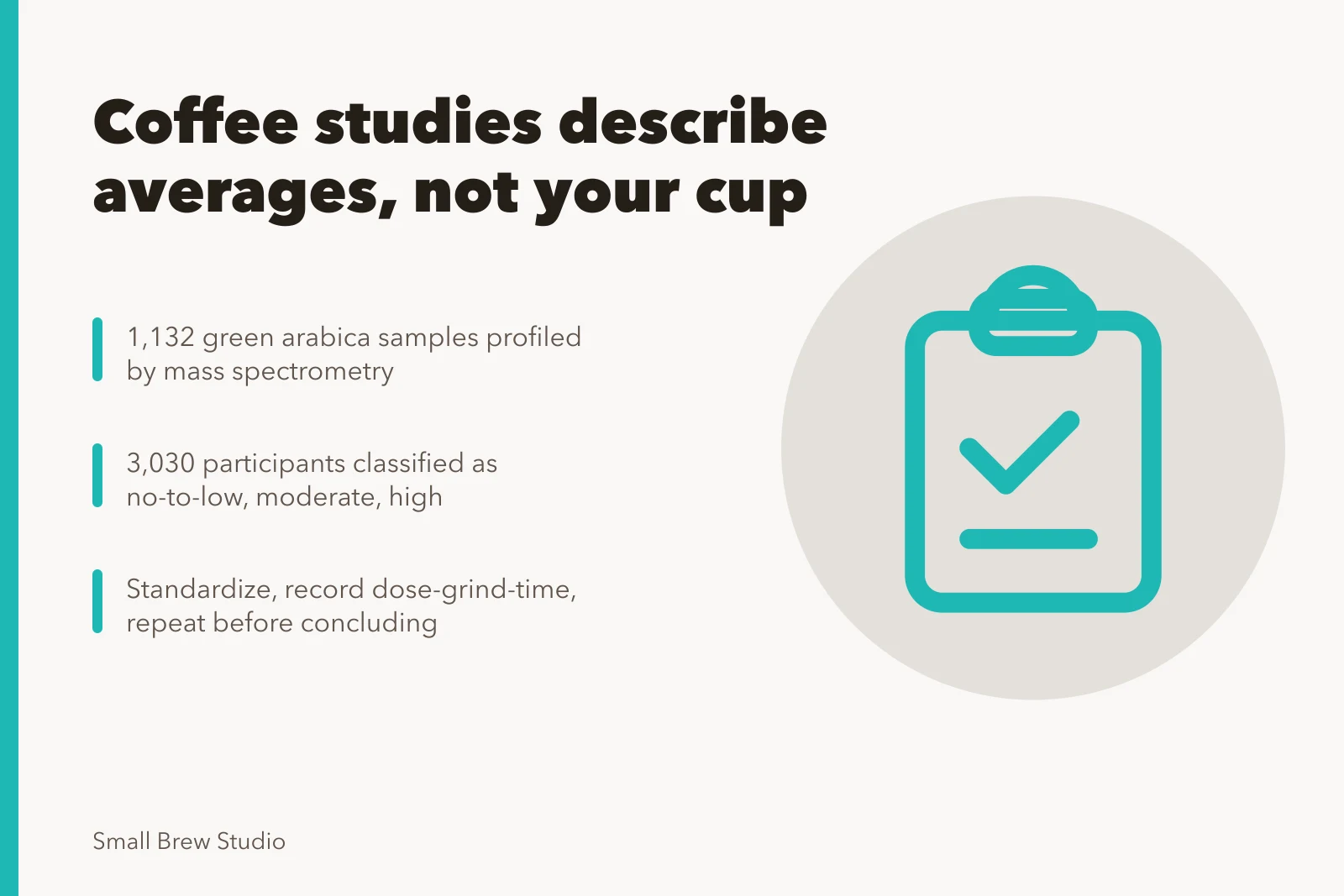
The instrumentation story is about volume. One study collected 1,132 green arabica samples worldwide, roasted them and profiled volatiles by proton transfer reaction time of flight mass spectrometry. Complex network analysis then built an overview of the volatile fingerprints of specialty coffees categorized by quality level, framed against traceability requirements and protection from fraud.
A thousand samples is a different kind of study from the twenty-sample experiments that dominated a decade ago. It makes classification by origin and quality tractable, and it is aimed at the supply chain rather than at drinkers. That is where it lands first, since traceability is turning from marketing into documentation.
Population studies of ordinary drinking
The other direction is asking large numbers of people what they drink. A cross-sectional study of 3,030 participants in a national headache and sleep survey classified coffee consumption as no-to-low, moderate or high.
It found that consumption tended to increase in the order of no headache, non-migraine headache, then migraine.
It noted the relationship between coffee and migraine remains contested.
That is a correlation in a survey, not a mechanism, and the paper says as much. It is useful mainly as a reminder that population associations rarely tell an individual what to do. Behind a counter the same caution applies, where the moderate summary is the whole of what is safe to say.
Why neither changes your morning
| Research direction | What it can tell you |
|---|---|
| Large volatile datasets | How a lot is classified, not how you will like it |
| Population surveys | What is associated across a population |
| Small sensory panels | What trained tasters detect under protocol |
| Your own repeated tests | What you prefer, reliably |
The last row is the only one about you. This is not anti-science, it is what personal variation implies: a result that holds across thousands of people can still fail to describe any particular kitchen.
What is genuinely worth borrowing
Three habits from research transfer well to a home setup. Standardize your conditions before you vary anything. Record the conditions, not just the outcome. And repeat before concluding.
Those three cost nothing, and they are the difference between an experiment and a morning. Standardizing means brewing your control recipe the same way for a week before you change anything, so you know your baseline rather than assuming it.
Recording means writing the dose, the grind and the time, not only the verdict, because a verdict without conditions cannot be compared later. Repeating means running the comparison a second time on a different day, with the order swapped, before you believe the result.
Applying all three to a defined question is the whole of the home experiment method, and the repetition step is the one people skip, which is why a structured two-cup comparison is worth learning properly.